
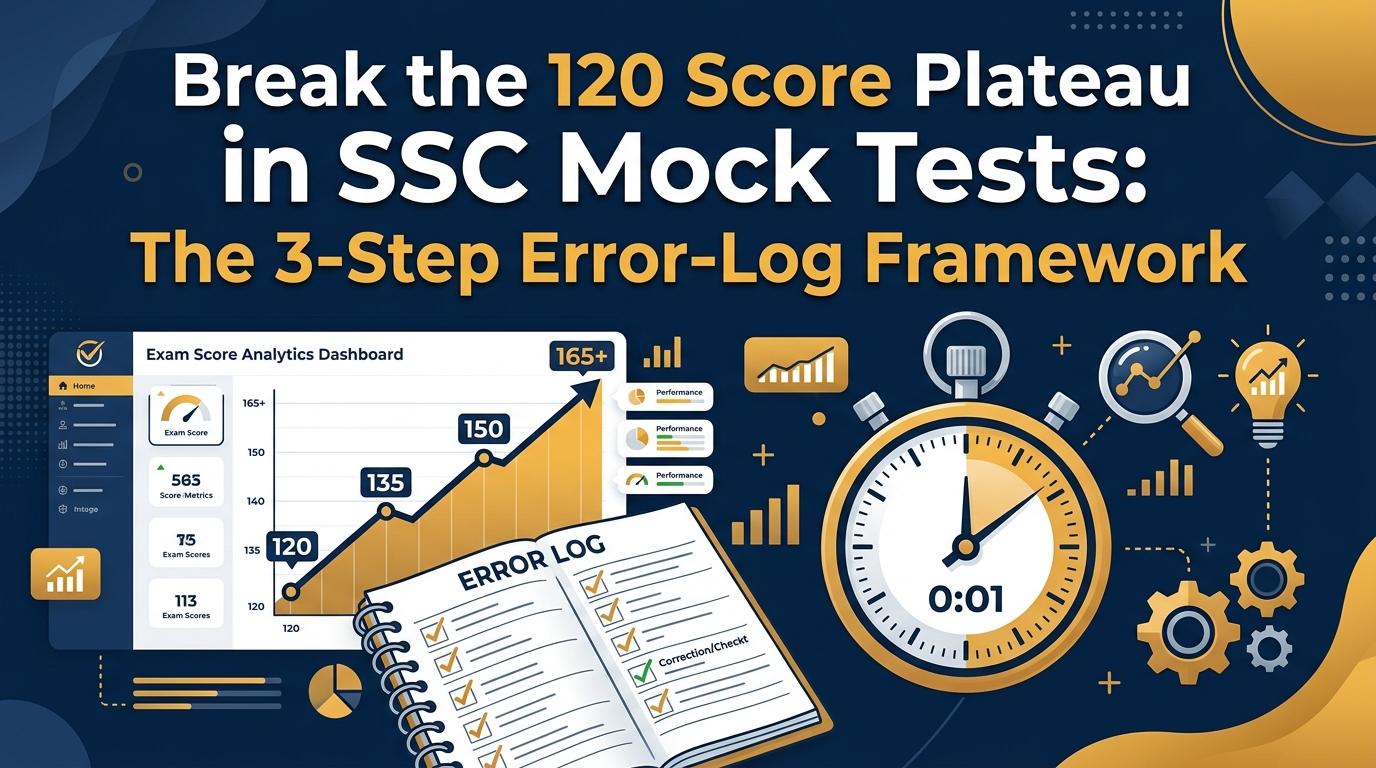
How to Break the 120 Score Plateau in SSC Mock Tests: The 3-Step Error-Log Framework
Tired of studying eight hours a day only to see your test score frozen between 120 and 128? Here is the exact diagnostic audit used by top rankers to purge negative marking and accelerate past 160.
Ready to Benchmark Your Current Score?
Apply this diagnostic framework on full-length mock tests simulating the authentic TCS exam environment.
The Psychology of the "120 Plateau" in SSC Mock Tests
You sit down at 9:00 PM. Room door locked. Phone silenced. You spend sixty intense minutes clicking through eighty-two questions. Your heartbeat spikes as you click "Submit Test."
The scorecard appears: 122.5 Marks.
You feel an immediate knot in your stomach. Two days ago, it was 124. Last Sunday, after completing an entire chapter of Mensuration, it was 119. You are putting in seven to eight hours of honest labor every single day. You have memorized formulas, solved thousands of previous-year questions, and watched hundreds of concept videos. Yet, your score line refuses to budge. It sits stubbornly between 120 and 128, month after month.
The Fatal "Quantity Trap"
When aspirants hit this wall, their default instinct is simple: take more tests. They believe that if thirty tests did not yield 150, taking sixty tests will. This is a catastrophic misconception. Taking mock tests repeatedly without structured surgical analysis does not build skill. It simply ingrains your subconscious flaws under adrenaline. You are merely practicing your mistakes at higher speeds.
Here is the fundamental reality: A mock test does not increase your knowledge; it merely exposes your leaks. Your score improvement never happens while taking the test. It happens entirely in the two hours AFTER the test is submitted.
The 3-Bucket Error Classification: Why Calling a Mistake "Wrong" Destroys Growth
Most candidates review their test by scrolling through red marks, reading the provided text solution for ten seconds, murmuring "Ah, I see," and moving on. This passive browsing creates an illusion of competence. It ensures that when a similar question appears four days later, you will commit the exact same error under time pressure.
To learn how to increase score in SSC mock test sessions, you must categorize every single lost mark into one of three distinct, non-overlapping diagnostic buckets:
You had no idea how to set up the equation, had never seen the underlying grammar rule, or had never encountered the historical fact. This is an information gap.
You knew the concept perfectly, yet marked the wrong option due to rough-sheet clutter, misreading the question stem, or calculating 7 × 8 as 54.
You refused to skip a stubborn geometry problem because you spent three days studying circles. You burned 140 seconds, panicked, and made wild guesses at the end.
Table 1: The 3-Bucket Error Taxonomy
| Error Category | Underlying Root Cause | Average Score Loss | Specific Remedial Action |
|---|---|---|---|
| Bucket A: Conceptual Blindspot | Incomplete syllabus coverage, unstudied grammar sub-rules, or unfamiliar static GK concepts. | 12 – 18 Marks | Do not take another test. Study the standalone chapter theory, solve 30 targeted drill questions, and update your reference notes. |
| Bucket B: Operational & Calculation Slip | Messy scratch paper, reading "diameter" instead of "radius", unit mismatch (km/h vs m/s), or sign reversal (+/-). | 15 – 22 Marks | Divide your rough paper into numbered quadrants. Re-read the final line of the question stem before clicking the radio button. |
| Bucket C: Time Panic & Ego Trap | Refusing to let go of a question, obsessing over speed without rhythm, and making rushed blind guesses in the final five minutes. | 10 – 16 Marks | Enforce the strict 45-Second Bailout Rule: If no clear calculation path emerges within 40 seconds, flag and skip immediately. |
- The Geometry Radius Trap: The question asks for the area of the base circle, but gives the diameter as 14 cm. You immediately plug r = 14 into πr² instead of r = 7, find your wrong answer listed as Option B, and click it with total confidence.
- The Inversion Grammar Trap: The sentence begins with "Scarcely had he arrived...". You fail to notice that the conjunction used in the second clause is "than" instead of "when", because you read the sentence at high speed without scanning for paired conjunctions.
- The Quadratic Sign Reversal: Factoring $x^2 - 5x + 6 = 0$, you write the factors as $(x-2)(x-3)$, but when asked for the roots, you accidentally select $(-2, -3)$ instead of $(+2, +3)$.
The Mathematics of Negative Penalties: The Devastating 2.5-Mark Swing
Aspirants chronically underestimate the arithmetic brutality of negative marking in SSC CGL Tier-1. When you get a question wrong, you do not just lose 0.5 marks. You lose the 2.0 marks you would have earned plus the 0.5 mark deduction. That is a net -2.5 mark swing away from your maximum possible score.
Table 2: The Net Negative Marking Swing Matrix
| Number of Blind Guesses | Nominal Negative Penalty | Total Opportunity Cost (Lost Marks) | Actual Score Difference |
|---|---|---|---|
| 4 Incorrect Guesses | -2.0 Marks | 8.0 Potential Marks Lost | -10.0 Net Swing |
| 8 Incorrect Guesses | -4.0 Marks | 16.0 Potential Marks Lost | -20.0 Net Swing |
| 12 Incorrect Guesses | -6.0 Marks | 24.0 Potential Marks Lost | -30.0 Net Swing |
| 16 Incorrect Guesses | -8.0 Marks | 32.0 Potential Marks Lost | -40.0 Net Swing |
The Accuracy Miracle: Real Candidate Case Study
Consider Student A and Student B, both attempting Tier-1 under official SSC notification guidelines:
• Total Attempts: 84 Questions
• Correct: 64 | Wrong: 20
• Gross Marks: 64 × 2 = 128.0
• Penalty: 20 × 0.5 = -10.0
Final Score: 118.0 Marks
• Total Attempts: 72 Questions
• Correct: 68 | Wrong: 4
• Gross Marks: 68 × 2 = 136.0
• Penalty: 4 × 0.5 = -2.0
Final Score: 134.0 Marks
Notice the revelation: Student B attempted twelve fewer questions, studied zero additional concepts, yet finished sixteen marks ahead of Student A. This is why revising core quantitative shortcut formulas to ensure absolute accuracy on easy questions yields immediate dividends.
Creating and Maintaining a Systematic "Mistake Diary"
If your test analysis does not leave physical ink on paper or a structured row in a spreadsheet, your analysis did not happen. Watching video solutions is entertainment; documenting your flaws is preparation.
A Mistake Diary is not a scrapbook where you copy entire questions. It is a razor-sharp diagnostic log where you document the exact point of failure. You must maintain either a spiral-bound physical notebook divided into four sections or a structured Notion/Excel sheet.
Table 3: The Complete Mistake Diary Template (Realistic Filled Entries)
| Subject & Shift | Question Snapshot & Misstep | Error Bucket | Root Flaw & Rule Correction | Action Item |
|---|---|---|---|---|
| Quantitative Aptitude Tier-1 Mock #14 | In a right triangle with sides 15, 20, 25, find the length of the altitude drawn to the hypotenuse. Calculated (15 + 20) / 2 instead of p = (a × b) / c. | Bucket B (Operational Slip) | Altitude on hypotenuse p = (Perpendicular × Base) / Hypotenuse = (15 × 20) / 25 = 12 cm. Used careless arithmetic intuition instead of geometric identity. | Verify against shift-wise solved PYQs and re-solve 5 similar altitude problems. |
| Reasoning Ability Tier-1 Mock #14 | Number series: 7, 11, 20, 36, 61, ?. Spent 135 seconds looking for alternating primes. Correct step was adding square increments: +4, +9, +16, +25, +36. | Bucket C (Ego / Time Panic) | Refused to skip when difference was not immediately obvious. Difference of differences: 4, 9, 16, 25, 36. Next term is 61 + 36 = 97. | Set a strict rule: If double-difference check fails after 30 seconds, mark for review and move on. |
| English Language Tier-1 Mock #14 | Sentence Correction: "Neither the teacher nor the students was present in the auditorium." Selected "No Error". | Bucket A (Conceptual Gap) | Subject-Verb Agreement Rule of Proximity: When subjects are joined by Neither... nor, the verb agrees with the closer subject ("students" → plural "were"). | Revise Neetu Singh Chapter 1 Subject-Verb Agreement proximity rules. Add 3 example sentences in notebook. |
The 48-Hour Blind Re-Attempt Protocol
Here is the golden rule of diagnostic testing: Never re-solve a missed question while looking at the explanation.
When you read an answer key and write down the steps, your brain takes mental shortcuts. It nods along with the teacher's logic. You feel that you have learned it. But in reality, you have only recognized the solution, not generated it. Retrieval practice is the only mechanism that converts working memory into long-term retention.
The 3-Step Execution Protocol:
After documenting missed questions in your diary, quarantine them for exactly 48 hours. Do not look at them during this window. Let short-term memory fade.
On Day 3, open the original question stems on a blank screen. Set a 45-second phone timer per question. Solve them with zero external notes or hints.
If you solve it correctly within 45 seconds, mark it with a green checkmark. If you hesitate or stumble again, it remains in the active review cycle for another 48 hours.
When you consistently apply this protocol while you practice on realistic TCS-interface tests, your leak rate plummets. You stop losing 20+ marks to careless mistakes. Your baseline score automatically surges from the 120s into the 150s.
The Balanced Weekly Execution Plan: Breaking the Daily Testing Trap
Aspirants who take one mock test every single morning end up emotionally exhausted by Thursday. They accumulate an enormous backlog of unanalyzed questions. They feel busy, but remain stagnant.
High-ranking candidates operate on a deliberate Test → Audit → Re-drill cycle. Two to three full tests per week provide more than enough diagnostic data to optimize your study schedule.
Table 4: The 6-Day High-Performance Weekly Routine
| Day | Focus Type | Target Activities | Audit Duration |
|---|---|---|---|
| Monday | Full Mock #1 + Deep Post-Mortem | Take full 60-min Tier-1 mock test under exam conditions. Immediately tag errors into Buckets A, B, and C. | 120 Minutes |
| Tuesday | Bucket A Conceptual Repair | Zero full tests. Study theory on missed topics using downloadable chapter worksheets. Solve 40 targeted chapter drill questions. | 60 Minutes |
| Wednesday | 48-Hour Blind Re-Attempt Protocol | Re-solve Monday's missed questions under a 45-second timer. Update Mistake Diary with green/red flags. | 45 Minutes |
| Thursday | Full Mock #2 + Deep Post-Mortem | Take second full-length mock test. Check whether Monday's calculation errors were repeated. | 120 Minutes |
| Friday | Speed & Sectional Accuracy Drills | Attempt 25-question sectional quizzes in Reasoning and English. Focus exclusively on maintaining 92%+ accuracy. | 60 Minutes |
| Saturday | Weekly Mistake Diary Grand Audit | Review all entries logged across the week. Blind re-attempt every flagged question. Plan the next week's focus topics. | 90 Minutes |
Frequently Asked Questions (FAQs)
Q1. How many mock tests should I take before SSC CGL Tier-1?
Quality thoroughly beats volume. For Tier-1, taking 35 to 45 full-length mock tests with complete 2-hour error audits is vastly superior to grinding 100 tests with superficial review. In the final 60 days before the exam, 2 to 3 tests per week provide the optimal balance between diagnostic testing, mistake logging, and targeted concept revision.
Q2. Should I attempt mock tests if my syllabus is only 60% complete?
Yes, immediately. Do not wait for 100% syllabus completion because that day rarely arrives. Starting full-length tests at 60% syllabus forces you to identify high-frequency recurring patterns, trains your mind to operate under time pressure, and teaches you the vital art of skipping questions you have not studied yet.
Q3. What is an ideal accuracy rate to target in SSC mock tests?
Aim for a minimum aggregate accuracy of 88% to 92%. Specifically, target 95%+ in Reasoning (48-50 marks), 90%+ in Mathematics (45+ marks), 88%+ in English Comprehension (42-45 marks), and 75%+ in General Awareness (25-30 marks). High attempts with mediocre accuracy (e.g., 85 attempts with 20 errors) will consistently anchor your score below 130.
Q4. How do I stop panicking when the timer drops below 15 minutes?
Timer panic happens when you enter the final quarter without a rigid section-order strategy. Adopt a fixed sequence: General Awareness (5-6 mins), English (10-12 mins), Reasoning (16-18 mins), and Mathematics (24-26 mins). When 15 minutes remain, you should only be working through your planned Quant questions, leaving zero unanswered easy questions behind in other sections.
Written by Arun
Senior Competitive Exam Strategist & Academic Director at Perfect Rank
Dedicated to helping aspirants achieve rank-defining accuracy through data-backed learning systems and diagnostic performance audits.
Have questions about your mock test error log? Start your diagnostic test series today.
Explore Free Mock Tests