
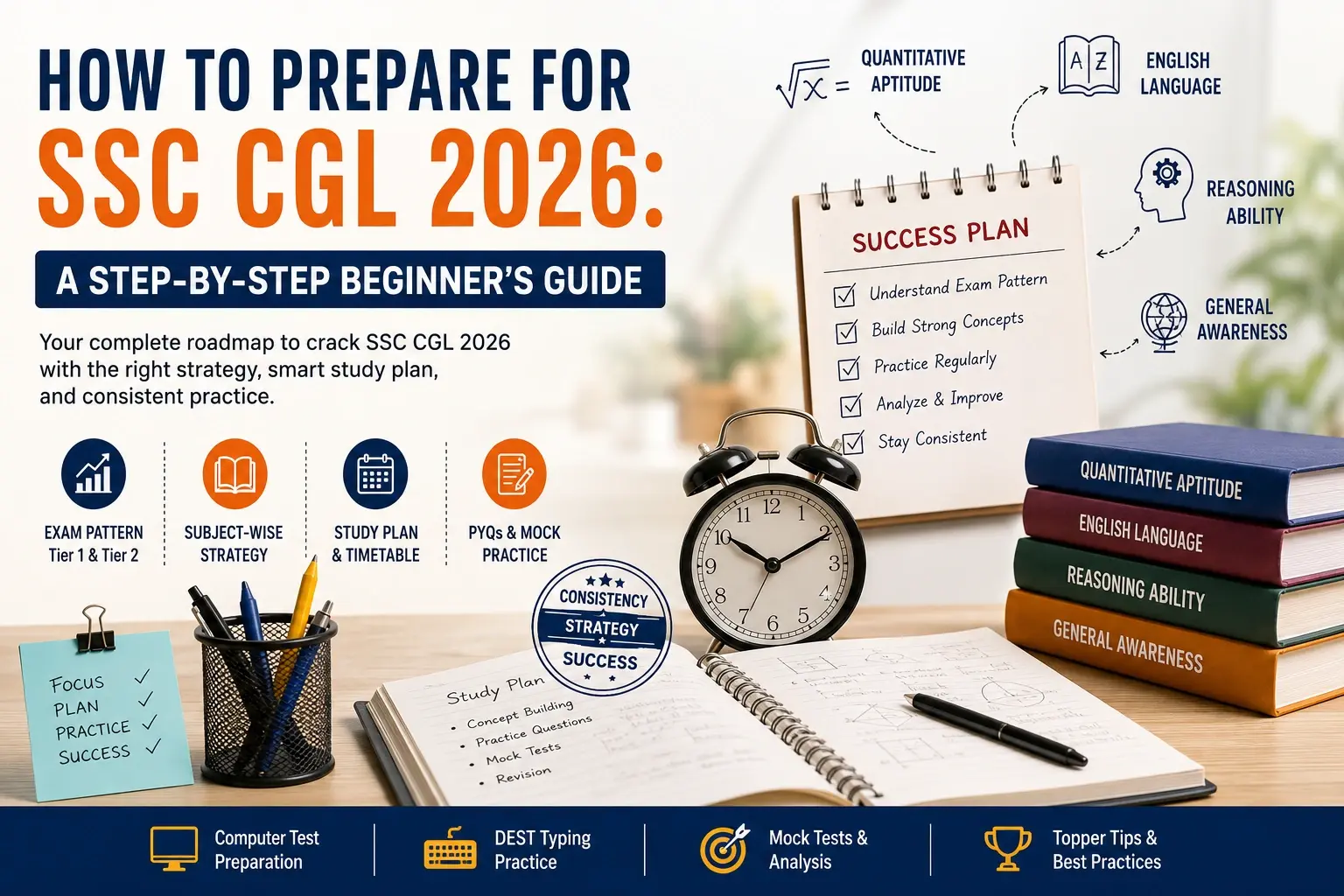
How to Prepare for SSC CGL 2026: A Step-by-Step Beginner’s Guide
The Combined Graduate Level (SSC CGL) exam is conducted every year to recruit graduates for coveted Group B and Group C posts within central ministries and government departments. Because millions of aspirants vie for a few thousand seats, the competition is exceptionally fierce. Success does not come from studying haphazardly for 12 hours a day; it comes from a structured strategy, regular evaluation, and absolute consistency. Beginners can start their preparation with our comprehensive SSC CGL Mock Test sets.
This comprehensive roadmap is designed to take you from a absolute beginner to an exam-ready aspirant for the 2026 cycle.
SSC CGL 2026 Quick Facts
Important information you should know before starting your preparation.
Exam Level
National
Mode
Online (CBT)
Selection Process
Tier 1 + Tier 2
Eligibility
Graduate
Negative Marking
Tier 1: -0.50
Tier 2: -1.00
Preparation Time
6–12 Months
Daily Study Hours
5–6 Hours
Best Practice
Weekly Mock Tests + PYQs
📑 Table of Contents
1. Understanding the SSC CGL 2026 Exam Pattern (Tier 1 vs. Tier 2)
Before purchasing books or building a timetable, you must understand the rules of the game. The SSC CGL exam is conducted in two computer-based stages: Tier 1 and Tier 2.
Tier 1: The Qualifying Screening Stage
Tier 1 is purely qualifying in nature. The marks you score here will not be added to the final merit list, but you must clear the official cutoff to move to the next stage. It consists of 100 multiple-choice questions worth 200 marks, to be solved in 60 minutes. Every incorrect answer carries a penalty of −0.50 marks.
Tier 2: The Final Merit-Deciding Stage
Tier 2 is where your final job selection and departmental allocation happen. It tests your conceptual depth across specific sections under strict time locks. The marking system here is harsher—each incorrect objective answer carries a steep penalty of −1.00 mark.
To ensure you understand how these scores, time constraints, and negative markings interact before starting your preparation, you can review the complete breakdown of negative marking and paper structures directly on the official SSC CGL Exam Pattern dashboard.
2. Core Subject-Wise Preparation Strategy
Every subject in the SSC ecosystem demands a distinct approach. Balancing your daily focus across these sections will help you build balanced scoring potential.
Quantitative Aptitude: Concepts vs. Calculation Speed
Mathematics can make or break your rank. For arithmetic and advanced geometry, your initial focus must be on conceptual clarity rather than short tricks. Start by revising foundational mathematical concepts, then move on to standard practice manuals.
- Geometry & Trigonometry: Maintain a dedicated formula notebook for theorems (such as similar triangles and angle bisectors) and trigonometric identities.
- Data Interpretation (DI): Practice processing tables, bar graphs, and pie charts daily. Speed up your calculation by memorizing squares up to 30, cubes up to 20, and fractional percentages.
English Language: Grammar Rules & Vocabulary Masterclass
English carries massive weightage in the final merit tier. To score exceptionally well, divide your preparation into three daily buckets:
- Reading: Read one newspaper editorial daily (from The Hindu or The Indian Express) to naturally build comprehension speed.
- Grammar: Master basic parts of speech and sentence structure rules. Keep a log of your errors during practice.
- Vocabulary: Dedicate time daily to idioms, phrasal verbs, antonyms, and one-word substitutions.
Reasoning Ability: High-Scoring Topics to Master First
Reasoning is generally the most scoring section and can be mastered quickly through pattern recognition. Focus on high-weightage chapters like Coding-Decoding, Analogies, Number Series, Syllogisms, and non-verbal reasoning (Mirror Images, Paper Folding). Developing speed here saves crucial minutes for the Mathematics section.
General Awareness: How to Balance Static GK & Current Affairs
Avoid the trap of reading endless random facts. Streamline your sources:
- Static GK: Follow reliable, concise general knowledge books for History, Indian Polity, Geography, and General Science (focusing heavily on Class 10-level Biology, Chemistry, and Physics).
- Current Affairs: Rely on consolidated monthly compilations or PDFs covering the last 6 to 8 months before the exam date, rather than scrolling through unverified social media updates.
Explore Other Mock Tests
Practice more government exam mock tests to improve your preparation.
3. How to Structure a High-Yield SSC CGL Study Timetable
Securing a top rank typically requires 6 to 12 months of structured preparation. Consistency beats intensity; studying 5 to 6 hours every single day with focus will yield far better results than studying 12 hours sporadically.
When designing your daily routine, distribute your hours systematically across topics. A balanced time-allocation strategy involves dedicated slots for core practice:
Quantitative Aptitude
English Language
Reasoning Ability
General Awareness
However, before mapping out your schedule, take a free diagnostic test via a high-fidelity SSC CGL Mock Test 2026 platform to see exactly where your speed and accuracy stand. This baseline score will show you exactly which subjects require more of your daily hours.
4. The Power of PYQs: Analyzing the 2025 Paper for a Competitive Edge
Unlike examinations that radically change their syllabus every year, the Staff Selection Commission is known for repeating core question frameworks. Nearly 70% to 80% of the mathematical types, grammatical error patterns, and vocabulary words are derived directly from the previous 4 to 5 years of official papers.
Analyzing the recent 2025 exam cycle gives you an immediate competitive edge. It shows you the exact phrasing, difficulty index, and fresh current affairs trends favored by the examiners. To reverse-engineer these historical patterns, try solving targeted micro-questions using SSC CGL chapter-wise tests that mimic the exact interface of the real computer-based exam. This lets you master one specific chapter's past questions before tackling full-length mock drills.
5. Don't Skip the Qualifying Rounds: Computer Test & DEST Typing
Many brilliant candidates score exceptionally high marks in Maths and English but face outright disqualification because they ignore the mandatory qualifying modules in Tier 2:
- Computer Knowledge Module: This objective test is mandatory. While its marks aren't added to the main merit score, failing to meet the baseline qualifying cutoff means elimination from the entire recruitment process.
- Data Entry Speed Test (DEST): You must clear a basic English typing accuracy barrier within a 15-minute window. Do not leave typing practice for the final week after Tier 2 results; dedicate 15 minutes to regular keyboard practice twice a week from the very start of your preparation.
Do’s and Don’ts for SSC CGL 2026
The Do's
- Stick to One Core Book per Subject: Multiple sources lead to confusion. Complete one standard text fully before picking up another.
- Maintain an Error Log: Write down every calculation error, forgotten formula, and tricky vocabulary word you encounter during practice. Review this log weekly.
- Simulate Real Exam Conditions: When practicing full-length tests, sit in a quiet room, use a strict countdown timer, and eliminate all phone distractions.
The Don'ts
- Do Not Guess Randomly: Haphazard guesswork will completely destroy your score due to the compounding effect of negative markings.
- Do Not Skip Mock Test Analysis: Spending an hour taking a test is useless unless you spend two hours analyzing your mistakes and unattempted questions.
- Avoid Source Overload: Do not follow dozens of different online channels or download endless PDF packages. Trust a single, structured routine and stick to it systematically.
Ready to Test Your Preparation?
Don't just study—measure your progress. Attempt free SSC CGL mock tests, practice chapter-wise questions, analyze your performance, and improve your speed and accuracy before the actual exam.
Practice Questions
Mock Tests
Performance Analysis
Online Practice