
Traditional Method vs 15-Second Smart Shortcut: A Side-by-Side Comparison for 7 Toughest SSC Arithmetic Problems
In SSC CGL Tier-1, you have 60 minutes for 100 questions. Spending 110 seconds writing “Let x = 100” on an arithmetic problem is an unforced error. Examine 7 authentic shift problems solved side-by-side: see the exact line where school algebra wastes time, and how clean ratio and deviation methods neutralize them in 15 seconds.
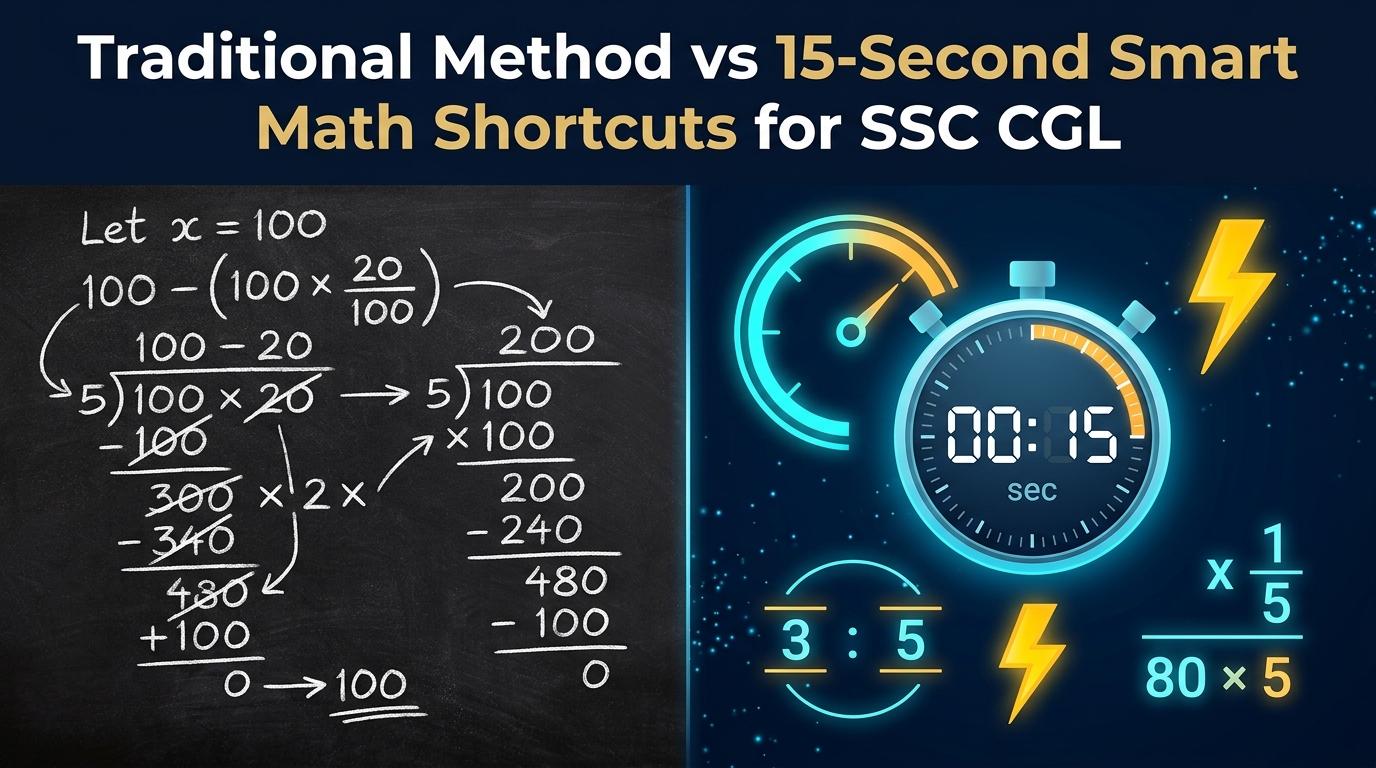
1. The Illusion of “Knowing” Mathematics
25 questions. 20 minutes allocated. That gives you exactly 48 seconds per question, including reading the prompt and bubbling the option. If you spend 120 seconds solving a single arithmetic question, you have mathematically guaranteed that two other questions will remain unread.
Every year, thousands of capable aspirants score 46 out of 50 during un-timed practice sessions at home, but crash to 28 out of 50 in the actual examination hall. The cause is rarely a conceptual deficit. The culprit is the subconscious reliance on middle-school algebra.
The Structural Flaw of School Math in Competitive Exams
School education rewards showing every intermediate step: assigning variables like x, writing down full algebraic statements, finding common denominators, and expanding quadratic expressions. In competitive testing, intermediate writing is friction. Every line of pencil work consumes 6 to 9 seconds of cognitive bandwidth.
Table 1: The Time-Drain Audit in SSC Arithmetic
| Arithmetic Topic | Traditional Time Taken | Smart Shortcut Time | Time Saved per Q | Cumulative Section Gain |
|---|---|---|---|---|
| Price & Consumption | 95 – 115 sec | 12 – 15 sec | 85 – 100 sec | +1.5 minutes |
| Dishonest Dealer | 110 – 130 sec | 15 – 18 sec | 95 – 112 sec | +1.8 minutes |
| CI – SI 3-Year Diff | 120 – 140 sec | 10 – 14 sec | 110 – 126 sec | +2.0 minutes |
| Alternate Time & Work | 105 – 125 sec | 18 – 22 sec | 85 – 103 sec | +1.6 minutes |
| Train Stoppage Speed | 85 – 100 sec | 8 – 10 sec | 75 – 90 sec | +1.3 minutes |
| Repeated Replacement | 115 – 135 sec | 14 – 18 sec | 100 – 117 sec | +1.8 minutes |
| Average Weight Deviation | 75 – 90 sec | 6 – 8 sec | 68 – 82 sec | +1.2 minutes |
2. The 3 Core Foundations of Calculation Speed
Tricks fail when they are treated as isolated gimmicks. Top rankers do not memorize hundreds of disjointed formulas; they operate on three foundational mental pillars that make shortcuts intuitive:
Never divide by 100 on scrap paper. When you see 16.66%, your hand must write 1/6 automatically. Converting percentages to reduced fractions eliminates long division before it starts.
Calculating the arithmetic mean by summing 25 numbers and dividing is school arithmetic. Competitive math measures net positive or negative shifts relative to an assumed baseline.
When two variables interact (such as Price × Consumption = Expenditure), express each parameter as an initial-to-final ratio. The missing term is obtained through direct multiplication.
Table 2: The Core Fraction-to-Percentage Rapid Multiplier Matrix
| Fraction | Percentage Equivalent | Decimal Value | Key Exam Multiplier Shortcut |
|---|---|---|---|
| 1/2 | 50% | 0.500 | Multiply by 0.5 or halve the integer |
| 1/3 | 33.33% (33 1/3%) | 0.333 | Base ratio transition: 3 → 4 (increase) or 3 → 2 |
| 1/4 | 25% | 0.250 | Quarter factor; 4 units become 5 or 3 |
| 1/5 | 20% | 0.200 | Standard multiplier: 5 → 6 (+20%) or 5 → 4 (−20%) |
| 1/6 | 16.66% (16 2/3%) | 0.166 | Replaces dividing by 6; crucial for Time & Work |
| 1/7 | 14.28% (14 2/7%) | 0.142 | Direct link with Mensuration circle radius multiples |
| 1/8 | 12.50% (12 1/2%) | 0.125 | Ratio factor: 8 → 9 or 8 → 7; standard in SI and CI |
| 1/9 | 11.11% (11 1/9%) | 0.111 | Repeating digit multiplier; complements 1/11 |
| 1/10 | 10% | 0.100 | Universal decimal shift; 10 → 11 or 10 → 9 |
| 1/11 | 9.09% (9 1/11%) | 0.090 | Crucial for divisibility tests and partnership ratios |
| 1/12 | 8.33% (8 1/3%) | 0.083 | Standard in month-to-year compound interest cycles |
| 1/13 | 7.69% (7 9/13%) | 0.076 | High-frequency TCS distractor rate in CI questions |
| 1/14 | 7.14% (7 1/7%) | 0.071 | Half of 1/7; Mensuration hemisphere base ratios |
| 1/15 | 6.66% (6 2/3%) | 0.066 | Discount series conversion (e.g. 15 → 16) |
| 1/16 | 6.25% (6 1/4%) | 0.062 | Principal unit power base: 16² = 256; 16³ = 4096 |
Download our comprehensive cheat-sheet with full 1/1 to 1/30 tables in our downloadable fraction-to-percentage reference sheets.
3. The 7 Side-by-Side Problem Deconstructions
Authentic SSC CGL Question:
The price of cooking oil rises by 33.33% (33 1/3%). By what percentage must a family reduce its consumption so that the overall household expenditure rises by only 10%?
| Aspect / Step | Traditional School Algebra (~105 sec) | Perfect Rank 15-Sec Shortcut (~12 sec) |
|---|---|---|
| Variable Assignment | Let initial price = ₹100, initial consumption = 100 kg. Initial Exp = 100 × 100 = ₹10,000. | Price ratio: 33.33% = +1/3 → Price = 3 : 4. Target Exp: +10% = +1/10 → Exp = 10 : 11. |
| Equation Setup | New Price = ₹133.33. New Exp = ₹11,000. Let new consumption = C. 133.33 × C = 11,000. | Since Consumption = Exp / Price: Consumption Ratio = (10/3) : (11/4) = 40 : 33. |
| Execution & Result | C = 11000 / 133.33 = 82.5 kg. Reduction = 100 − 82.5 = 17.5%. (Requires long division). | Reduction = (40 − 33) / 40 = 7/40 = 7 × 2.5% = 17.5% (Option A). Pure mental math. |
Why It Works: Expenditure equals Price multiplied by Consumption. Cross-multiplying the fractional ratios gives the direct change in consumption without dealing with recurring decimals.
Authentic SSC CGL Question:
A grocery merchant advertises that he sells rice at cost price, but he uses a false weight of 850 grams instead of 1 kilogram (1000g), and additionally gives a 10% discount on the customer's total bill. Find his net profit or loss percentage.
| Aspect / Step | Traditional School Algebra (~120 sec) | Perfect Rank 15-Sec Shortcut (~15 sec) |
|---|---|---|
| Cost Baseline | Let CP of 1000g = ₹1000 ⇒ CP of 1g = ₹1. CP of 850g given to customer = ₹850. | Weight Multiplier: Customer gets 850g for 1000g charge ⇒ Ratio = 1000 / 850 = 20 / 17. |
| Selling Price Calculation | Marked price = ₹1000. Customer gets 10% discount ⇒ SP = 1000 − 100 = ₹900. | Discount Multiplier: 10% discount ⇒ Ratio = 9 / 10. |
| Profit Percentage | Net Profit = 900 − 850 = ₹50. Profit % = (50 / 850) × 100 = 500 / 85 = 5.88%. | Net Multiplier = (20/17) × (9/10) = 18 / 17. Profit = 1/17 = 5.88% (Option A). Done in 2 lines. |
Why It Works: Multiplying successive ratio factors captures both the weight advantage and the discount markdown simultaneously, eliminating the need to assume absolute currency numbers.
Authentic SSC CGL Question:
The difference between compound interest compounded annually and simple interest on a certain principal sum for 3 years at 10% per annum is ₹930. Find the principal sum.
| Aspect / Step | Traditional Formula Expansion (~135 sec) | Perfect Rank 15-Sec Shortcut (~10 sec) |
|---|---|---|
| Formula Writing | CI = P[(1 + r/100)³ − 1]; SI = (P × r × 3) / 100. Diff = P[(1.1)³ − 1 − 0.30]. | Effective Rate Method: SI for 3 yrs @ 10% = 30.0%. CI for 3 yrs @ 10% = 33.1%. |
| Expansion & Algebra | Diff = P[1.331 − 1 − 0.30] = 0.031P. 0.031P = 930. P = 930 / 0.031. | Net Difference Rate = 33.1% − 30.0% = 3.1%. |
| Resolution | Multiply numerator and denominator by 1000: 930,000 / 31 = ₹30,000. | 3.1% = ₹930 ⇒ 1% = ₹300 ⇒ 100% Principal = ₹30,000 (Option A). Solved in 8 seconds! |
Why It Works: 10% compounded for 3 years is always 33.1% by Pascal triangle (3:3:1 ratio). Subtracting the 30% SI leaves an immediate 3.1% unit difference. Check our complete arithmetic formula reference guide for the 2-year and 3-year difference identities.
Authentic SSC CGL Question:
A can complete a piece of work in 12 days, B in 15 days, and C in 20 days. If they work on alternate days in the sequence A on Day 1, B on Day 2, C on Day 3, A on Day 4, and so on, in how many days will the entire work be completed?
| Aspect / Step | Fraction Addition Approach (~115 sec) | Total Work LCM Units Shortcut (~18 sec) |
|---|---|---|
| Work Definition | Let total work = 1. A's 1-day work = 1/12, B = 1/15, C = 1/20. | Total Work = LCM(12, 15, 20) = 60 units. Efficiency: A = 5, B = 4, C = 3 units/day. |
| Cycle Summation | Work in 3 days = 1/12 + 1/15 + 1/20 = (5 + 4 + 3)/60 = 12/60 = 1/5 of total. | 1 Cycle (3 days) = 5 + 4 + 3 = 12 units. |
| Final Calculation | Number of 3-day periods = 1 / (1/5) = 5 periods. Total days = 5 × 3 = 15 days. | Total Cycles = 60 / 12 = 5 full cycles. Total Days = 5 × 3 = 15 days (Option A). Zero fractions! |
Why It Works: Replacing the abstract number 1 with the LCM of the individual completion times turns cumbersome fraction addition into whole-number integer arithmetic.
Authentic SSC CGL Question:
An express train travels without stoppages at an average speed of 72 km/h, and with scheduled stoppages at an average speed of 60 km/h. How many minutes does the train stop on average per hour?
| Aspect / Step | Distance-Time Derivation (~90 sec) | Perfect Rank Direct Formula (~8 sec) |
|---|---|---|
| Concept Setup | In 1 hour without stoppage, distance = 72 km. In 1 hour with stoppage, distance = 60 km. | Direct Rule: Stoppage Time per hour = [(Fast − Slow) / Fast] × 60 mins. |
| Calculation | Lost distance due to stopping = 72 − 60 = 12 km. Time required to cover 12 km at full speed = 12 / 72 hour. | Fast = 72, Slow = 60 ⇒ Difference = 12. Ratio = 12 / 72 = 1/6. |
| Conversion to Minutes | Time in minutes = (12 / 72) × 60 = (1/6) × 60 = 10 minutes. | (1/6) × 60 minutes = 10 minutes (Option A). Solved mentally in 5 seconds. |
Why It Works: The deficit in distance covered per hour is solely attributable to stoppage time, which represents lost motion at the unhindered speed.
Authentic SSC CGL Question:
A vessel contains 40 liters of pure milk. From this vessel, 4 liters of milk are drawn out and replaced with water. This exact operation is performed one more time. How much pure milk remains in the vessel now?
| Aspect / Step | Standard Formula Application (~125 sec) | Successive Ratio Reduction (~14 sec) |
|---|---|---|
| Step 1: Removal Ratio | Formula: Remaining = Initial × [1 − y/x]². y = 4, x = 40. | Fraction removed each cycle: 4 / 40 = 1/10 ⇒ Fraction retained = 9/10. |
| Step 2: Squaring | Remaining = 40 × [1 − 4/40]² = 40 × [1 − 0.1]² = 40 × (0.9)². | After 2 operations: Retained multiplier = (9/10)² = 81 / 100. |
| Step 3: Multiplication | Remaining = 40 × 0.81 = 32.40 liters. | 40 × (81/100) = 4 × 8.1 = 32.4 liters (Option A). Solved in one mental line. |
Why It Works: Each withdrawal diminishes the pure liquid concentration by a fixed factor of 1/10th. Squaring the retained fraction yields the remaining quantity instantly. Verify these recurring problems on official shift-wise solved PYQ papers.
Authentic SSC CGL Question:
The average weight of 24 students in a classroom is 46 kg. When the class teacher joins the group, the new average weight increases by 400 grams (0.4 kg). What is the weight of the teacher?
| Aspect / Step | School Sum Multiplication (~80 sec) | Perfect Rank Net Deviation (~6 sec) |
|---|---|---|
| Step 1: Old Total Sum | Total weight of 24 students = 24 × 46 = 1,104 kg. (Requires scratchpad multiplication). | Baseline Weight = Old Average = 46 kg. |
| Step 2: New Total Sum | New group size = 25. New average = 46.4 kg. Total = 25 × 46.4 = 1,160 kg. | Total People in new group = 24 + 1 = 25. Increase brought per person = 0.4 kg. |
| Step 3: Difference | Teacher's Weight = 1,160 − 1,104 = 56 kg. | Teacher = 46 + (25 × 0.4) = 46 + 10 = 56 kg (Option A). Done in 5 seconds without scratchpad! |
Why It Works: The teacher must bring their own 46 kg baseline plus an additional 0.4 kg for all 25 members in the room (25 × 0.4 = 10 kg). Summing the two yields the answer with zero multi-digit multiplications.
4. Mastering Formulas Without Rote Memorization
Shortcuts become dangerous liabilities when misapplied outside their boundary conditions. For instance, using the stoppage formula when route distances differ, or applying the 3:3:1 Pascal triangle method when interest rates change annually, will produce flawed options that TCS paper setters deliberately engineer.
Always anchor every speed technique to its underlying mathematical proof once. Review the complete mathematical derivations in our complete arithmetic formula reference guide before committing them to reflex.
5. The 3-Stage Transition Rule: Unlearning School Algebra
You cannot shift your operational thinking overnight. Attempting shortcuts for the first time inside an actual examination causes hesitation. Follow this structured 3-stage protocol:
Solve Traditionally First
Solve the question using your regular algebraic method during untimed practice. Confirm that your conceptual logic is sound.
Immediate Shortcut Replication
Immediately resolve the exact same problem using ratio multipliers or deviation. Notice where the algebra compressed into two lines.
Timed Mock Simulation
Apply the technique under live countdown conditions on full-length TCS-pattern mock tests. Track whether your pencil work dropped below 3 lines.
Check official examination schedules and updates regularly on the official SSC examination portal.
Why Perfect Rank is Best for SSC Quantitative Aptitude Preparation?
Transforming math from a time-drain section into a 50-out-of-50 scoring sprint requires practicing under authentic conditions:
Start full-length TCS interface tests and chapter quizzes immediately without creating accounts, entering phone numbers, or hitting paywalls.
Experience real TCS-pattern computer-based test layouts, live countdown clocks, bilingual language toggling, and accurate official negative marking rules.
Every problem includes detailed conceptual explanations plus ratio, unit digit, and digital sum shortcuts to solve in under 15 seconds.
Post-test diagnostic reports categorize your unforced errors into conceptual gaps, calculation slips, and time-panic traps.
Join Our Telegram Channel for Instant Math Shortcuts!
Get daily exam shift analysis, free downloadable PDF worksheets, handwritten shortcut formula notes, and real-time notification alerts directly on your phone.
Related Articles & Preparation Guides
View All Blogs
10 Deadliest TCS Trap Questions in SSC Math & Reasoning (And 10-Sec Hacks)
Discover how TCS examiners design deceptive options and how toppers eliminate them in 10 seconds.
How to Break the 120 Score Plateau in SSC Mock Tests: The 3-Step Error-Log
Stuck between 120-130 in mock tests? Eliminate negative marks and push your score past 160.
50 Most Important Quantitative Aptitude Formulas for SSC Exams
High-yield arithmetic and algebra formulas with TCS solved examples and shortcut applications.
Frequently Asked Questions (FAQ)
Q1.Are shortcut methods reliable for SSC CGL Tier-2 where question difficulty is higher?
Shortcut methods are not shortcuts in mathematical rigor; they are algebraic identities and proportional ratios reduced to their final operational form. In Tier-2, questions feature multi-tier calculations. Using ratio multipliers and deviation saves 45 to 60 seconds per question, which directly prevents running out of time in the final 10 problems.
Q2.What if I forget the shortcut formula during the actual exam?
True speed methods do not rely on memorizing obscure magic formulas. They are built on foundational principles like fraction-to-percentage equivalence, unitary balance, and weighted deviation. If you understand why the ratio inverts, you never need to rely on rote memory.
Q3.Which chapters have the highest time-saving potential through Ratio methods?
Profit, Loss & Discount, Time & Work, and Mixtures & Alligations yield the highest immediate gains. Traditional algebraic solutions require setting up simultaneous equations taking 90 to 120 seconds, whereas ratio standardization resolves them in 15 to 20 seconds.
Q4.How long does it take to unlearn the traditional school math habit?
Most aspirants require approximately three weeks of disciplined daily practice. The key is never checking the answer key until you have actively re-solved the problem using clean unit fractions instead of writing let x equal 100 on your rough paper.
Written by Shivlal | Chief Curriculum Architect & Founder, Perfect Rank
Dedicated to replacing tedious school algebra with competitive-grade calculation intelligence.
Speed is not inborn; it is an engineered mechanical habit. Stop writing middle-school variable steps on scrap sheets. Adopt proportional unit multipliers, audit your calculations by unit digits, and let your competitors waste their 120 seconds while you submit your Quant section with 10 minutes to spare.